

News
With "ZEUGMA", Romain Bernini, in residence at Fontevraud, brings the abbey and the museum of modern art into resonance through several unexpected and poetic proposals.
By linking words and ideas of different natures, a "Zeugma 01" generates the unexpected. In his artist residency at Fontevraud, it is the artist Romain Bernini who forms the link between the abbey and the museum, creating a subtle alchemy between the works on display…
As part of this artist residency, titled "Zeugma O1", curated by Dominique Gagneux and Emmanuel Morin, the idea is to play with this same logic of assembly and juxtaposition. In this project, the invited artist will be that link. He will establish new connections between the Royal Abbey and the Fontevraud museum of modern art.
The aim is not simply to bring the two sites face to face, but to explore unexpected relationships, to create a subtle alchemy between the works on display. Through the two proposals, the residency invites the artist to experiment with new modes of representation, to redefine the relationships between spaces, forms and ideas.
How did Romain Bernini imagine linking the works in the museum's collection to Fontevraud's architectural ensembles? The verticality and power of the site impose a relationship to the sacred that is also found in many objects in the museum expressing various forms of spirituality.
Although the walk through its rooms is horizontal, and although any hierarchy between the works is abolished there, the artist experienced something similar to what he felt in the abbey — he perceived the same intensity there and identified the same subject: that of a humanity that must manage its relationship to the intangible.
For the artist, the temptation is strong to show how buildings and works of art shed light on our own relationship to transcendence — the very thing that leads us to create a painting, a building, a song.
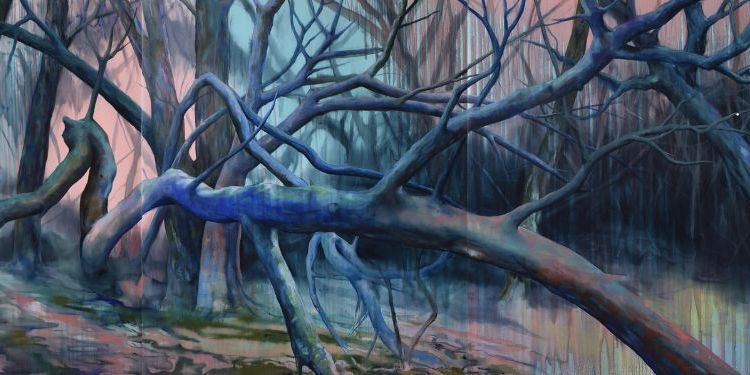
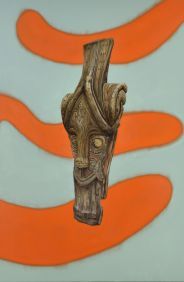
To this end, Romain Bernini uses the sites as creative material or iconographic material: images, architecture and objects are apprehended, interpreted and then shifted so as to enter into painting.
It is through direct reference, mise en abyme, or the translation of certain works from the collection that Romain Bernini's proposal expresses the possible connections between the museum and the heritage site — connections that do not tighten around a single linear narrative but, on the contrary, encourage the emergence of multiple narratives around the universal search for the sacred.
The exercise also involves integrating into this work elements that were already present in his oeuvre, such as trees or animal eyes, giving them a new dimension.
Born in 1979, Romain Bernini lives and works in Paris. He creates a pictorial body of work nourished by reflections on colour, space, rites, popular culture and non-Western art. Whether depicting lush and enigmatic landscapes, masked or painted contemporary shamans, exotic animals, or strange and undefined zones, Romain Bernini's works reveal a margin of the world, the possibility of ecstasy or a balance between the real and the utopian. Romain Bernini is represented by the Suzanne Tarasiève gallery (Paris).
Fontevraud