

Actualité
New stained-glass windows for Fontevraud — François Rouan

The Royal Abbey of Fontevraud, the largest monastic complex in Europe, is located in the Loire Valley, listed as a UNESCO World Heritage site. It is today brought to life by a cultural project led by the Pays de la Loire Region, which contributes to the dynamism and appeal of the area, and offers a diverse audience a programme combining history, music and contemporary creation.
This dialogue between heritage and creation, this clash between permanence and rupture, is an integral part of the project. The refectory of the Grand-Moûtier cloister embodies it: permanence of function, of the rule of silence, of the ritual of the meal; a brutal rupture of eras and occupants within this very monument of stone, which within just a few years went from a great centre of spirituality to a feared place of confinement.
The Royal Abbey of Fontevraud carries in its very fabric all the traces and symbols of the history of our great Western civilisation. Its architecture sublimates the markers of the density of time. The Abbey leads a cultural project that upholds the duty to pass on and renew our way of seeing through the gesture of artists.
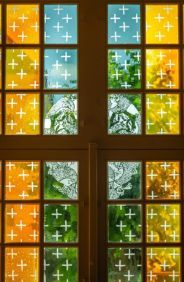
It is in this spirit that the Pays de la Loire Region called upon François Rouan to create stained-glass windows in the great refectory, in place of the current windows.
This commission concerns the south and north façades. It aims to insert glazing into the existing openings, which are undergoing full restoration by the State.
François Rouan's work rigorously articulates material, colour and structure.
It is rooted in a profound reflection on support and pictorial gesture, resonating with the questions of light specific to the art of stained glass. His work creating stained-glass windows for Nevers Cathedral, the Château de Hautefort and the Château de Bonaguil confirmed the relevance of his intervention within a heritage setting, guaranteeing a contemporary work that dialogues harmoniously with the existing architecture.
"Through this proposal, a dialogue takes place between the two walls of the building and finally finds its resolution, from a symbolic standpoint, in the attempt to reconcile — or even bring together — transparency and opacity, the secular and the spiritual, notably through the motif of the triskelion, and ultimately between all the layers and strata that History has bequeathed to us, from the most trivial to the most majestic." — François Rouan
Fontevraud